

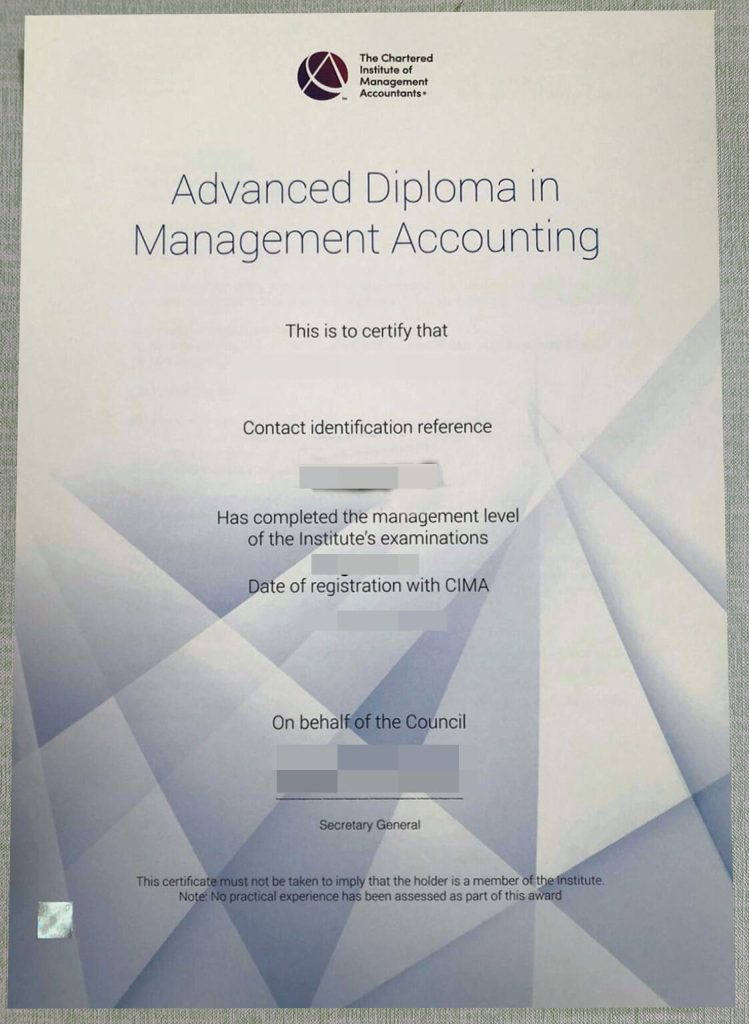
The CIMA Advanced Diploma in Management Accounting is a professional qualification awarded by the Chartered Institute of Management Accountants (CIMA), a globally recognized professional body specializing in management accounting, business finance, and strategic decision-making. It represents an important milestone in the CIMA professional qualification pathway and demonstrates that candidates have developed advanced knowledge of management accounting, financial reporting, and business performance management.
Understanding what the CIMA Advanced Diploma is equivalent to can help students, employers, and professionals evaluate its academic level, career value, and opportunities for further study.
1. What Level Is the CIMA Advanced Diploma?
The CIMA Advanced Diploma in Management Accounting, abbreviated as CIMA Adv Dip MA, is awarded after completing the Management level of the CIMA professional qualification. This level follows the Operational level and precedes the Strategic level. Candidates must complete the required examinations, including the Management Case Study examination, to obtain the diploma.
In the United Kingdom, the qualification is listed at Level 7 in the government’s learning aims database. However, this classification should be interpreted carefully because qualification-framework levels and academic degrees are not interchangeable in every context.
Level 7 generally corresponds to the level associated with postgraduate qualifications in the UK framework. Nevertheless, the CIMA Advanced Diploma is a professional accounting qualification, not automatically equivalent to a master’s degree. Universities and qualification assessment organizations make their own decisions about academic equivalency and credit recognition.
2. Is the CIMA Advanced Diploma Equivalent to a Master’s Degree?
One of the most common questions concerns whether the CIMA Advanced Diploma is equivalent to a master’s degree, such as an MSc in Accounting and Finance or an MBA.
Although the diploma covers advanced professional subjects, it should not automatically be considered equivalent to a completed master’s degree. A master’s degree normally requires completion of a university-approved academic program, while the CIMA Advanced Diploma represents completion of a specific stage of a professional qualification.
Some universities may recognize relevant professional qualifications when assessing applications for postgraduate study. However, admission decisions depend on the institution, program requirements, previous academic qualifications, and professional experience.
Students planning to use the diploma for university admission, employment, or immigration purposes should obtain written confirmation from the relevant institution or assessment authority.
3. What Knowledge and Skills Does It Demonstrate?
The CIMA Advanced Diploma demonstrates knowledge in three principal areas. These include managing organizational and individual performance, applying advanced management accounting techniques, and preparing and interpreting financial information.
Candidates develop skills in budgeting, cost management, performance evaluation, financial reporting, resource allocation, and business decision-making. These competencies are valuable in organizations where finance professionals work closely with management teams to improve efficiency and profitability.
The qualification also emphasizes the relationship between financial information and wider business objectives, helping candidates understand how accounting supports operational planning and management decisions.
4. Career Opportunities After Completing the Diploma
The CIMA Advanced Diploma can strengthen a candidate’s profile when applying for positions such as management accountant, financial analyst, business analyst, budgeting specialist, and finance supervisor. Depending on previous experience and employer requirements, candidates may also progress toward management-level responsibilities.
However, completing the diploma does not automatically grant full CIMA membership or the Chartered Global Management Accountant (CGMA) designation. Candidates must complete the remaining Strategic level requirements and satisfy the applicable practical experience requirements to achieve the full professional qualification.
5. Conclusion
The CIMA Advanced Diploma in Management Accounting is a valuable professional qualification that demonstrates advanced management accounting and financial management knowledge. It is listed at Level 7 in the UK government’s learning aims database, but this does not mean it is automatically equivalent to a master’s degree.
For students and professionals seeking career development in finance, accounting, and business management, the diploma provides an important step toward completing the CIMA qualification. Its precise academic equivalency should always be confirmed with the relevant university, employer, or credential evaluation authority.